
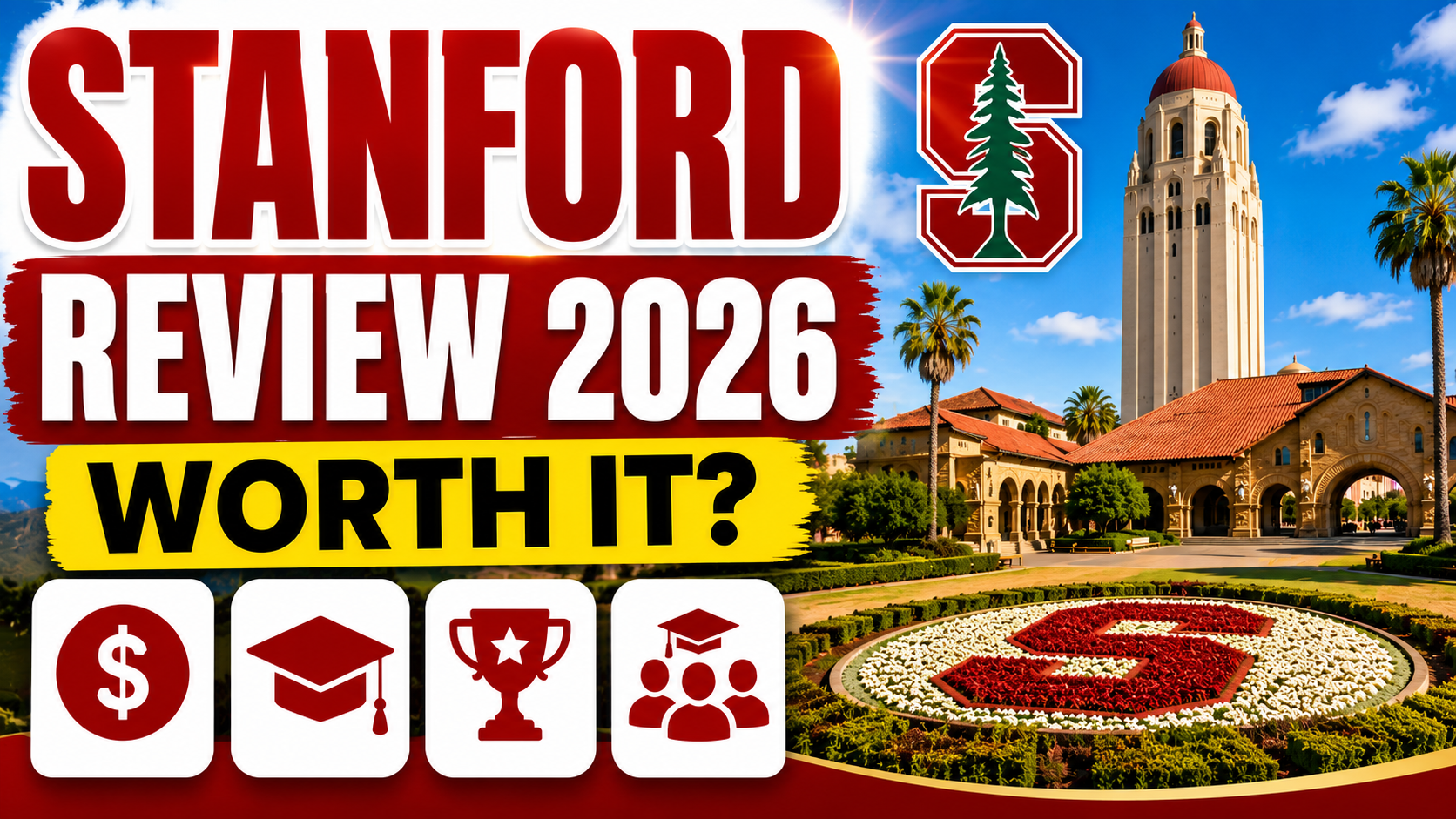
Stanford University Review 2026: Is It Worth It? Cost, Acceptance Rate, Rankings & Student Life
If you’ve heard people call Stanford “the Harvard of the West” — or, these days, just call Harvard “the Stanford of the East” — there’s a reason. Tucked between Palo Alto and the heart of Silicon Valley, Stanford has grown from a grieving couple’s memorial gift into one of the most influential universities on the planet. Here’s an honest, plain-English look at what Stanford actually is, how it started, what it offers students, and what it takes to get in.
The Origin Story :-
Stanford wasn’t born out of a government charter or a religious mission — it was born out of grief. In 1884, Leland Stanford Jr., the only child of railroad magnate and former California governor Leland Stanford and his wife Jane, died of typhoid fever just before turning 16. Devastated, the couple decided that since they could no longer do anything for their own son, they would dedicate their fortune to “the children of California.” That decision became the founding grant of November 1885, and the university opened its doors on October 1, 1891, to 555 students on the family’s former horse farm — which is why the campus is still nicknamed “the Farm” today.
From the very beginning, Stanford broke from tradition: it admitted men and women equally at a time when most elite universities were male-only, and it was nonsectarian when most peer schools had religious affiliations. Frederick Law Olmsted, the same landscape architect behind New York’s Central Park, helped design the campus, giving it the sandstone buildings and red-tile roofs that are now instantly recognizable.
How Stanford Became a Tech Powerhouse :-
Stanford’s rise as a global research powerhouse is closely tied to Silicon Valley itself. Engineering professor and later provost Frederick Terman — often called the “Father of Silicon Valley” — actively encouraged students to start their own companies rather than just work for existing ones. That mindset helped launch firms like Hewlett-Packard, and it set the tone for decades of Stanford-linked startups. In 1951, the university created the Stanford Industrial (now Research) Park, cementing the relationship between the campus and the tech industry growing up around it. Later landmarks include groundbreaking gene-splicing research by chemist Paul Berg (which helped birth modern biotechnology and earned him a Nobel Prize), and the 1997 development of the PageRank algorithm by two graduate students named Larry Page and Sergey Brin — who went on to found a small company called Google.
Campus at a Glance :-
Stanford’s main campus spans about 8,353 acres in Stanford, California, on the San Francisco Peninsula — making it one of the largest university campuses in the country, roughly 37 miles southeast of San Francisco and about 20 miles northwest of San Jose. Because the land was originally a horse-breeding farm and the founding grant stipulated it could never be sold, huge stretches remain open space, foothills, and nature preserve rather than buildings. The core academic campus, centered on the historic Main Quad and Memorial Church, is walkable and sits within about a mile of most classrooms and dorms.
A few more physical details worth knowing:
- The campus holds 630 buildings (per Stanford’s own current count) and more than 20 libraries, making it one of the largest academic library systems in the country.
- Notable landmarks include Hoover Tower, the Main Quad with its distinctive sandstone-and-red-tile architecture, the Rodin Sculpture Garden, and Lake Lagunita, a seasonal lake on the central campus.
- Stanford also runs specialized off-campus facilities, including the Jasper Ridge Biological Preserve (a large natural reserve used for ecological research), the SLAC National Accelerator Laboratory (home to one of the world’s longest linear particle accelerators), and the Hopkins Marine Station on the California coast.
- The Hoover Institution, a public policy think tank, is also based on campus.
Academics and Campus Life :-
Stanford today is organized into seven schools, all located on a single, sprawling campus — a setup the university says fuels interdisciplinary collaboration between fields like engineering, medicine, business, humanities, and law. The seven schools are Business, the Doerr School of Sustainability, Education, Engineering, Humanities and Sciences, Law, and Medicine. The university runs on a quarter system, which lets students sample a wider variety of classes than a typical two-semester calendar allows.
A few numbers that stand out, based on Stanford’s own current data (Autumn 2025):
- Student-to-faculty ratio: about 6 to 1
- Total enrollment: 7,289 undergraduates and 10,025 graduate students — about 17,300 students overall
- Faculty: 2,402 faculty members, including 20 Nobel laureates who are currently members of the Stanford community (36 Nobel laureates total have been affiliated with the university across its history), along with numerous Pulitzer Prize winners, MacArthur Fellows, and National Medal recipients
Popular undergraduate majors include Computer Science, Economics, Human Biology, Engineering (of various types), and interdisciplinary programs like Science, Technology, and Society. Graduate offerings range from the well-known Graduate School of Business and School of Medicine to the School of Law and the Graduate School of Education.
On the cost side, Stanford’s official student budget for the 2026–2027 academic year lists undergraduate tuition at $67,731, with a total estimated cost of attendance (tuition, housing and food, fees, books, and personal expenses) of $97,545. That said, sticker price rarely tells the real story. Financial aid is genuinely one of Stanford’s strongest selling points: under its need-based aid program, the university covers full tuition for admitted students from families earning under $150,000 a year, and covers tuition, room, and board for families earning under $100,000. For the 2025–2026 year, the minimum expected student contribution is $5,000. Stanford does not offer merit-based scholarships — its aid is based entirely on financial need, admission for U.S. citizens and permanent residents is need-blind, and admitted U.S. students are not expected to take out loans to attend.
Athletics: The Cardinal :-
Stanford’s sports teams compete as the Cardinal in NCAA Division I, primarily in the Atlantic Coast Conference (ACC). The athletics program is the most decorated in the country: as of the 2025–26 season, Stanford has won 138 NCAA team championships, more than any other university, and has captured at least one NCAA team title every year for 50 consecutive years running — a streak dating back to 1976–77. Stanford athletes have also combined for 335 Summer Olympic medals all-time (162 gold, 93 silver, 80 bronze), including a school-record 39 medals at the 2024 Paris Games alone. Notable athletes connected to Stanford include golfer Tiger Woods (who attended on a golf scholarship) and astronaut Sally Ride, who was also the top player on Stanford’s tennis team before her career at NASA.
Notable Alumni and Faculty :-
Stanford’s alumni and faculty network reaches deep into government, science, business, and culture. Herbert Hoover, the 31st U.S. President, was a member of Stanford’s first graduating class. Sandra Day O’Connor, the first woman to serve on the U.S. Supreme Court, is also an alumna. Sally Ride, the first American woman in space, earned multiple degrees at Stanford. On the business side, Stanford’s connection to Silicon Valley runs through graduates like Google co-founders Larry Page and Sergey Brin, Netflix co-founder Reed Hastings, and Nike co-founder Phil Knight, among many others who built major technology and consumer companies after leaving campus. Author John Steinbeck attended Stanford for several years, though he left without graduating.
Getting In: What the Numbers Look Like :-
Let’s be direct: Stanford is one of the hardest schools in the world to get into. Recent admissions cycles have seen acceptance rates hovering around 3.5–4%, meaning the overwhelming majority of applicants — many of them highly qualified — are turned away. A few things worth knowing if you’re considering applying:
- Stanford uses the Common Application or the Coalition Application, plus several short, Stanford-specific essays.
- Standardized testing is required, not optional: after going test-optional in 2020, Stanford reinstated the SAT/ACT requirement starting with applicants to the Class of 2030 (those applying in fall 2025 for fall 2026 entry), and this requirement continues for current and future cycles. Every first-year applicant must submit either an SAT or ACT score, though self-reported scores are accepted at the application stage and official scores are only required upon enrollment.
- Admitted students typically post very strong academic records, along with meaningful extracurricular achievement — Stanford’s process is holistic, meaning grades and test scores are only part of the picture. Essays, recommendations, and demonstrated intellectual curiosity all matter.
- Regular Decision applications are typically due in early January, with Restrictive Early Action due around November 1. Because deadlines shift slightly year to year, always confirm the current dates before applying.
Where Stanford Stands Globally :-
Stanford consistently ranks among the top handful of universities worldwide across major global ranking systems, generally landing in the top 2–3 spots on lists like the QS World University Rankings, Times Higher Education, and the Shanghai (ARWU) rankings. On the domestic side, the ranking most commonly cited by U.S. readers — U.S. News & World Report’s National Universities ranking — currently places Stanford at No. 4, alongside a No. 4 ranking for having one of the lowest acceptance rates in the country. (Global and domestic rankings use different methodologies, which is why the numbers don’t match — worth keeping in mind if you see both cited.) Stanford is especially strong in computer science, engineering, and business, and its location — a short drive from San Francisco and walking distance to the startup ecosystem of Silicon Valley — gives students access to internships, mentorship, and networking opportunities that are hard to replicate anywhere else.
The Bottom Line :-
Stanford earns its reputation honestly: a genuinely beautiful, historic campus; deep, real ties to the technology industry that shapes the modern economy; generous financial aid for families who need it; and academic breadth that spans everything from Renaissance literature to rocket propulsion. The catch, of course, is getting in — admission is brutally competitive, and there are no shortcuts around strong grades, real achievement, and a compelling personal story.
If you’re researching Stanford for an application, a school project, or just out of curiosity, treat this as a starting point rather than the final word — admissions policies, tuition figures, and rankings shift from year to year, so it’s always worth cross-checking the latest details before relying on them.
Sources: Facts and figures in this article were compiled from Stanford University’s official public pages, including its Facts site, Financial Aid Office, Undergraduate Admission site, University Bulletin, and Athletics site (stanford.edu, facts.stanford.edu, financialaid.stanford.edu, admission.stanford.edu, gostanford.com), along with Encyclopaedia Britannica for historical cross-checking. Third-party rankings referenced are from QS World University Rankings, Times Higher Education, the Shanghai/ARWU rankings, and U.S. News & World Report.
Disclaimer :-
This is an independent, informational article. It is not affiliated with, endorsed by, or produced by Stanford University. Figures such as tuition, admissions statistics, and rankings change year to year — always confirm current details directly with the university before relying on them.