
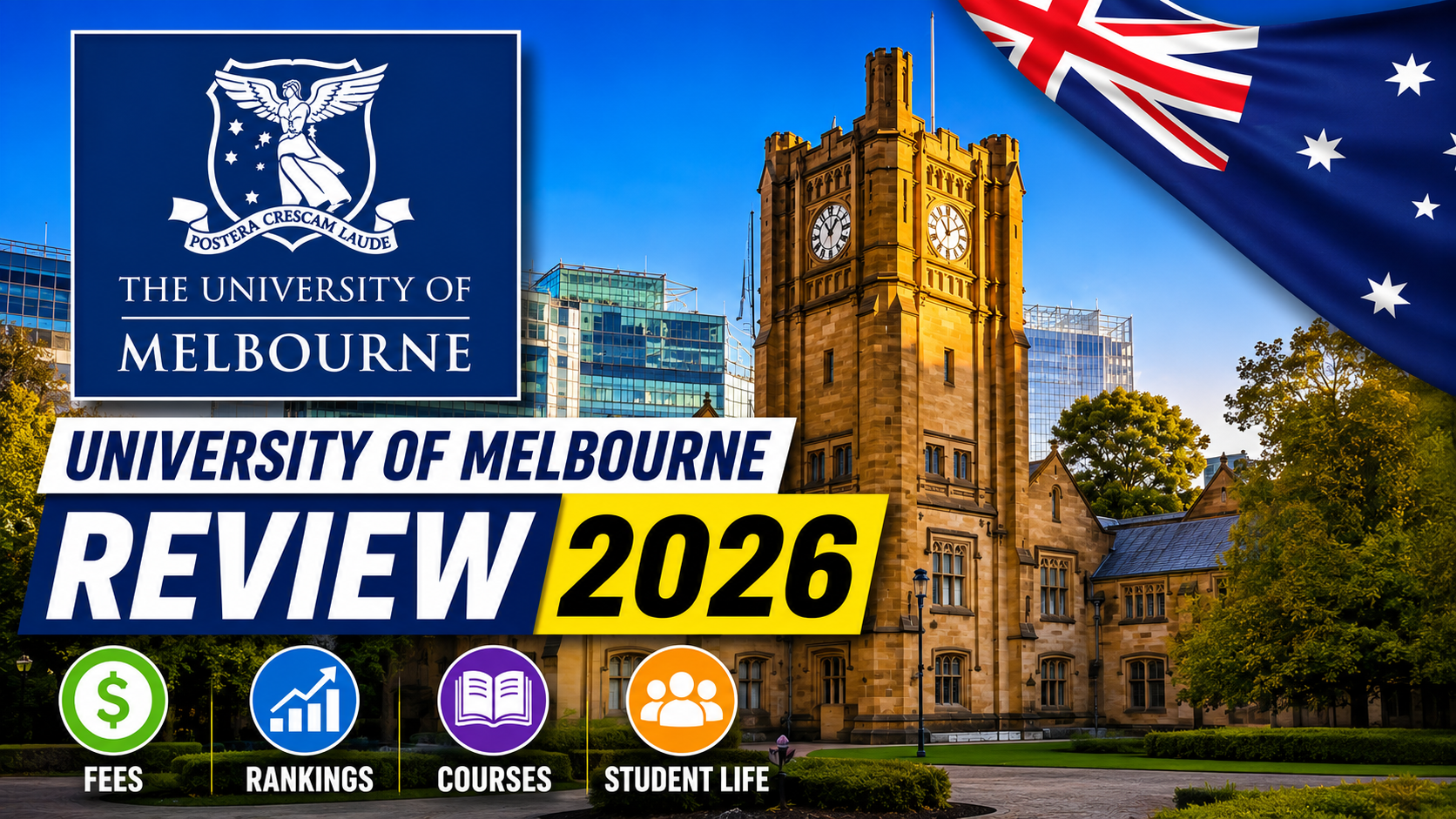
University of Melbourne Review 2026: Fees, Rankings, Courses & Student Life
If you’ve spent any time researching Australian universities, chances are the University of Melbourne (usually just called “UniMelb” or “Melbourne Uni” by everyone who actually goes there) keeps popping up at the top of the list. It’s the kind of school that gets thrown around in conversations about “the best in Australia,” and honestly, most of the time that reputation holds up. But is it the right fit for you? That depends on a few things worth unpacking properly, rather than just taking a glossy prospectus at its word.
This review pulls from the university’s own official channels — mainly unimelb.edu.au, study.unimelb.edu.au, students.unimelb.edu.au (official fee tables), VTAC, and the university’s published rankings data — so you’re getting the real picture, not marketing spin. Wherever the university itself doesn’t publish an exact figure (like a single acceptance rate), this article says so explicitly rather than presenting a third-party estimate as official fact.
Quick Note Before You Start :-
This version is written specifically for Australian citizens, permanent residents, and eligible New Zealand citizens applying from within Australia. If that’s you, your application, ATAR requirements, and fees look quite different — and generally cheaper — than what’s advertised for international students. We’ve put that information front and centre below.
A Quick Snapshot :-
The University of Melbourne was founded in 1853, making it Australia’s second-oldest university and the oldest in Victoria. It’s part of the “Group of Eight,” a coalition of the country’s most research-intensive universities. The main campus sits in Parkville, a leafy inner-north suburb a short tram ride from the Melbourne CBD, and the university now spans eight campuses across Victoria, including specialist sites for veterinary science (Werribee), agriculture (Dookie), forestry (Creswick) and performing arts (Southbank).
It’s a big place. The university’s own facts and figures page puts total enrolment north of 50,000 students, with roughly 47% studying at undergraduate level and 53% in graduate programs — a split that reflects Melbourne’s distinctive teaching model, more on that below.
How Australians Actually Apply :-
How you apply: Instead of applying directly to the university, you apply through VTAC (the Victorian Tertiary Admissions Centre) using your ATAR — not a percentage-based school result or an English test.
As a guide, recently published guaranteed ATARs include 91.00 for the Bachelor of Science (2026) and 88.00 for the Bachelor of Arts (2026) — though the “lowest selection rank” that actually got people in has been a bit lower in past years (89.00 and 86.00 respectively for 2025 entries). These numbers shift year to year and by course, so check the specific course page on study.unimelb.edu.au before assuming anything applies to you.
Admission is also genuinely course-specific — there’s no single “75–93%” cutoff that applies university-wide. You’ll need to have completed the VCE (or a recognised equivalent), meet the minimum ATAR for your specific course, and complete any prerequisite subjects. Always check the entry score on the actual course page rather than relying on a general figure.
What you don’t need to worry about: No IELTS or English test, no international application fee, no upfront tuition deposit, and no Overseas Student Health Cover (OSHC) — all of that is specific to the international student pathway and doesn’t apply to you as a domestic applicant.
Applications through VTAC open according to the standard VTAC calendar each year; check the current dates on vtac.edu.au and study.unimelb.edu.au, as they can shift slightly year to year.
What You’ll Actually Pay :-
This is the part people care about most, so let’s be precise. Most domestic undergraduates get a Commonwealth Supported Place (CSP), meaning the Australian Government pays part of your course cost and you pay the rest — your “student contribution amount.”
This isn’t one flat fee. It’s charged per subject, based on which discipline band that subject falls into, set annually by the federal government. Bands vary widely — as real examples from the official 2026 rates: a typical humanities subject in the “English” cluster costs $4,738 per EFTSL (a full-time-equivalent subject load, roughly $592 for a standard 0.125 EFTSL subject), while Commerce, Law, Business and Economics subjects sit at the top of the scale at $17,399 per EFTSL (around $2,174 per subject) — this is the band most Bachelor of Commerce and Melbourne Law students will actually be paying. Built-environment subjects (architecture, construction, planning) cost around $1,192 per individual subject, which works out to roughly $9,537 for a full year’s EFTSL load. Your actual yearly cost depends entirely on your subject mix, so don’t assume a single “average” figure applies to you — check your course’s discipline bands on students.unimelb.edu.au.
How you pay it: You don’t need the money upfront. If you’re an Australian citizen or eligible permanent humanitarian visa holder, you can defer your student contribution through a HECS-HELP loan, which you only start repaying once your income crosses the government’s minimum repayment threshold after graduating. There’s also a Student Services and Amenities Fee (SSAF), which can similarly be deferred through SA-HELP.
On top of CSPs, the university offers a solid range of scholarships, including the Melbourne Chancellor’s Scholarship program, along with financial hardship support and short-term loans for students in genuine need — worth looking into regardless of your ATAR or financial situation.
Where It Actually Sits in the Rankings :-
This is where things get interesting, and where a lot of older articles floating around online are now out of date. For years, Melbourne held the title of Australia’s number-one university across the major global rankings. That changed in mid-2026.
In the 2027 QS World University Rankings (released June 2026), the University of New South Wales edged ahead to claim the top domestic spot, with Melbourne landing at 22nd globally — still a strong result, and up from 42nd a decade ago, but no longer Australia’s outright number one on that particular table. On the other two big global rankings, though, Melbourne is still holding its ground as Australia’s top-ranked institution: 37th in the Times Higher Education World University Rankings and 38th in the Academic Ranking of World Universities (the Shanghai Ranking).
Subject-by-subject, Melbourne remains genuinely excellent. It’s the only Australian university ranked in the top 50 globally across all five broad QS subject categories — Arts and Humanities, Engineering and Technology, Life Sciences and Medicine, Natural Sciences, and Social Sciences and Management — and it leads the country in 22 individual subject areas. So while the “Australia’s #1” crown has shifted for the moment, the depth of academic strength across disciplines is still hard to match.
The takeaway: don’t rely on a single ranking number to make your decision. Melbourne’s strength is its consistency across almost every field, not just one flashy headline position.
The “Melbourne Model” — Love It or Hate It :-
One thing that sets Melbourne apart from most Australian universities is its course structure, known as the Melbourne Model. Instead of jumping straight into a specialised professional degree (like law or medicine) as an 18-year-old, most undergraduates start with one of several broad bachelor’s degrees — Arts, Science, Commerce, Biomedicine, Design, Music or Environments — before specialising through a postgraduate degree.
The idea is flexibility. You get to explore a bit before locking in a career path, and it mirrors the structure used at places like Harvard and Melbourne’s own international peers. The catch is cost and time: many professional pathways (like medicine or law) now require an extra postgraduate degree on top of your undergraduate one, which means more years of study and, since postgraduate coursework fees aren’t always covered by a CSP, potentially higher costs down the track. It’s a genuine trade-off, and it’s worth thinking hard about whether you want breadth now or a faster, more direct professional pipeline.
Courses and Faculties :-
Melbourne offers several hundred programs across ten faculties, covering everything from Agriculture, Fine Arts and Music through to Engineering, Law, Medicine and the Melbourne Business School. According to the university’s own handbook, popular postgraduate options include the Master of Data Science, Master of Engineering, Master of Business Analytics and the MBA delivered through Melbourne Business School.
Some standout areas worth knowing about:
- Medicine and Life Sciences rank among the strongest in the country, and Melbourne’s research output in areas like neuroscience and oncology is genuinely world-class.
- Law consistently ranks in the global top tier, and Melbourne Law School has a strong reputation among Australian employers.
- Business and Commerce, through Melbourne Business School, holds AACSB and EQUIS accreditation — two of the most respected global business school accreditations.
- Engineering and IT is expanding significantly, with a new $2 billion Fishermans Bend campus focused on engineering.
Campus Life :-
Parkville is genuinely a nice place to spend a few years. It’s essentially its own small suburb, with its own postcode, seven libraries holding millions of books and items, more than 200 student clubs, over 40 sports clubs, and a solid strip of cafes if you need a coffee between lectures (and in Melbourne, you will need a coffee). The campus is a short walk or tram ride from the CBD, so you’re never far from the city if you want a change of scenery.
Beyond Parkville, the university has eleven affiliated residential colleges offering accommodation and community life — worth looking at if you’re moving from regional Victoria or interstate — plus specialist campuses that give students hands-on access to facilities you won’t find at a typical inner-city university, think working farms, forestry research stations and veterinary hospitals.
Acceptance Rates: What’s Actually Known :-
Worth being upfront about this one: the University of Melbourne does not publish an official institution-wide acceptance rate. Any “70%” or “77%” figure you see quoted online comes from third-party education consultancies making estimates, not from the university itself, so treat those numbers as rough guidance, not fact. What we do know for certain is that individual high-demand courses (Medicine, for instance) are far more selective than any headline acceptance figure would suggest, and for domestic students, entry into those courses is driven by your ATAR and any course-specific selection tasks (such as interviews or aptitude tests) rather than a general acceptance percentage.
What Students Actually Get Out of It :-
Beyond the rankings and the sandstone buildings, what matters is outcomes. Melbourne graduates are consistently reported as being among the most employable in the country, and the university’s QS scores for employer reputation and graduate employment outcomes are among the strongest of any Australian institution. Alumni have gone on to work across major employers, government, and research institutions both in Australia and internationally, and the university counts Nobel laureates and former prime ministers among its graduates.
If You’re Applying From Overseas :-
Everything above is written for Australian citizens, permanent residents, and eligible New Zealand citizens. If you’re applying as an international student instead, your pathway is different: you’ll apply directly to the university (not through VTAC), you’ll need an IELTS score (typically 6.5 overall, no band below 6.0, higher for some programs like Doctor of Medicine), you’ll pay a non-refundable AUD $154 application fee, and tuition is charged per subject at international rates rather than through a Commonwealth Supported Place — for example, the Master of Science (Computer Science) sits at AUD $64,000 per year, with a required AUD $17,000 tuition deposit on acceptance. You’d also need Overseas Student Health Cover (OSHC). Check study.unimelb.edu.au’s international pages directly, as none of the domestic guidance above (VTAC, ATAR, CSP, HECS-HELP) applies to that pathway.
The Honest Verdict :-
The University of Melbourne earns its reputation, but it’s not automatically the right choice for everyone. If you want a broad, flexible education, access to serious research opportunities, and a genuinely lively campus in one of the world’s most liveable cities, it’s hard to go past. If you want the fastest, most direct route into a specific profession without extra postgraduate study, the Melbourne Model is worth thinking through carefully — it’s a real commitment of both time and money.
It’s also worth remembering that rankings shift year to year, and 2026 saw Melbourne lose its long-held “Australia’s #1” title on the QS table specifically, even while holding firm elsewhere. That’s not a red flag — it’s just a reminder that no ranking tells the whole story, and the right university for you depends on your course, your ATAR, your budget, and what kind of student experience you’re actually after.
For the most accurate and current details on ATARs, CSP places, HECS-HELP, and specific courses, always go straight to the source: study.unimelb.edu.au, unimelb.edu.au, and vtac.edu.au are the official channels, and course-specific information changes often enough that it’s worth double-checking there before you apply.
Disclaimer:-
This article is an independent, unofficial review and is not affiliated with, endorsed by, or produced by the University of Melbourne. All fees, ATARs, rankings and admission figures reflect information published as of mid-2026 and are subject to change without notice. This content is general information only — not financial, legal, or education advice — and should not be relied on as the sole basis for any enrolment or financial decision. Always verify current, course-specific figures directly with the University of Melbourne via study.unimelb.edu.au, students.unimelb.edu.au, and vtac.edu.au before applying or accepting an offer.